This is Part II of a lengthy piece on South African wine. Read Part I here.
In Part I, I used the anarchic camaraderie of the Zoo Cru to illustrate something fundamental about South African wine: its unusual culture of collaboration. But collegiality alone cannot explain the country’s astonishing momentum. South Africa’s excitement comes from a convergence of ancient landscapes, old vineyards, stylistic relevance, brilliant hospitality, and a depth of winemaking talent that few regions can match.
Phenomenal Raw Materials
Those of us in the wine business often like to point out that the places where wine grows around the world are beautiful, which is true for the most part. But few bits of wine country can hold a candle to the sweeping beauty of South Africa.
Spectacular mountain vistas plunge toward the sea; craggy windswept highlands transform to lush protea-filled forests hosting troops of baboons; remote moonlike rocky plateaus can feel otherworldly. Some corners of the country feel positively tropical while, elsewhere, stretches of bounteous farmland offer idyllic pastoral views.
The landscape of South Africa demands your attention and rewards your gaze at every turn. Anyone who comes over the pass into the valley of Franschhoek and fails to have their breath taken away should probably just be put out of their own misery.
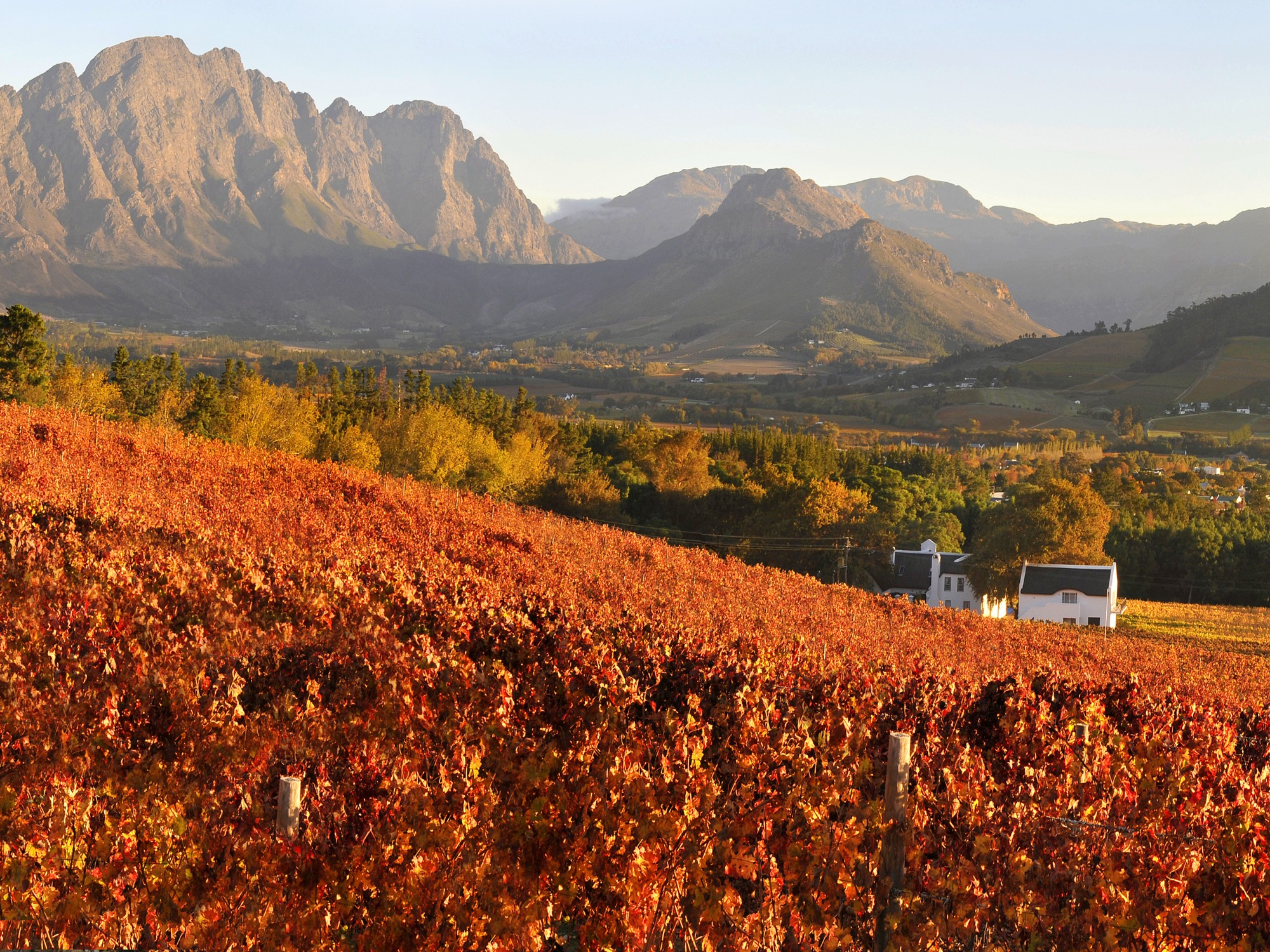 The Franschhoek Valley in autumn – photo by Eddie Wilson courtesy of Wines of South Africa
Geologically speaking, a trip through the South African landscape represents an excursion into deep time. The country features some of the globe’s oldest, well-preserved exposed rocks and layers formed by sedimentary and volcanic activity, dating to more than 3.22 billion years ago.
Unlike some younger landscapes shaped primarily by tectonic uplift and volcanic eruptions, South Africa’s peaks, valleys, plains, and plateaus have largely been carved by billions of years of wind and water, helped by occasional cataclysms such as continental collisions and asteroid impacts. That geological complexity has left the Cape with an extraordinary mosaic of soils capable of supporting a wide range of grapevines.
South Africa’s wine country sits within a broadly Mediterranean climate, with warm, dry summers and cool, wet winters. But conditions vary tremendously throughout the Cape. Much of the Western Cape is cooled by the Atlantic Ocean and its icy Benguela Current, which generates fog and sends moisture-laden breezes into coastal vineyards during the growing season.
The country’s jagged mountains add even more variation. Elevation, slope, aspect, and distance from the sea can produce distinctly different mesoclimates within very short distances. Rainfall also varies dramatically, generally diminishing as you move north and inland, from relatively lush coastal and mountain sites to arid places where the survival of dry-farmed vineyards can seem almost miraculous. These climatic differences allow South Africa to ripen an enormous range of grape varieties. They have also helped produce an equally remarkable diversity of native plant life.
On top of South Africa’s stones and soil sits one of the world’s most diverse ecological zones, the Cape Floristic Region, sometimes known as the Cape Floral Kingdom. A combination of Mediterranean climate, infertile soils, recurrent wildfires, and wildly varying landscapes has contributed to the evolutionary isolation of the region. The resulting environment encouraged millions of years of what biologists call speciation, or the proliferation of new and different species from existing ones.
The Cape Floral Kingdom is the smallest of six floral kingdoms around the world, but the most diverse of them relative to its size. It hosts approximately 9,000 different plant species, of which more than 6,200 are found nowhere else on Earth. The characteristic vegetation of the kingdom is known as fynbos, a mix of dazzling floral plants such as…
Source : https://www.vinography.com/2026/08/why-south-africa-is-the-most-exciting-wine-region-on-the-planet-part-ii