
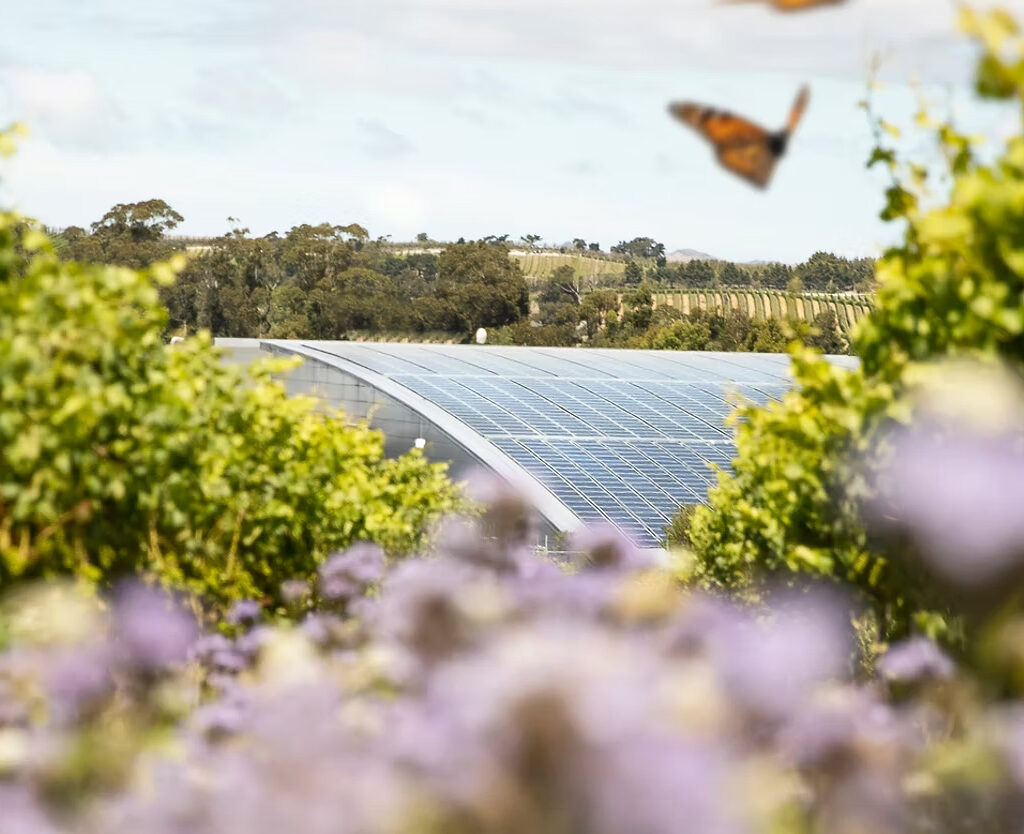
The wine world is full of organizations and associations, spanning a wide range of missions, purposes, and themes. Only a few, however, are focused on saving the planet. One of those, International Wineries for Climate Action, came to Napa earlier in the year to offer a tasting they billed as the largest tasting of low-emission wines ever held in Napa.
I didn’t know much about the IWCA before the tasting. I had read headlines and an occasional article about the group, but was vague on the details. After this tasting and a deep dive into what they’re doing, I consider them one of the most impressive wine organizations on the planet.
Founded by Familia Torres and Jackson Family Wines in 2019, the organization was launched to create a community of wineries dedicated to reducing greenhouse gas emissions in the wine lifecycle towards a goal of complete carbon neutrality. The idea being that in collaboration and with shared purpose, wineries can do more, faster, than if they each go at it alone.
That sounds like a pretty good idea, right? But once you have the idea, you very quickly become faced with the question of how the heck to do that effectively and efficiently, and more specifically, you have to figure out what to focus on first.
And that is a lot harder than it sounds.
In order to know where to focus, you need to know where you stand, which involves something called carbon accounting. Basically, you need to measure and/or calculate your carbon footprint as a wine business across the entirety of the wine lifecycle: planting, farming, winemaking, packaging, marketing, sales, hospitality, waste, business operations, and energy use, to name just a few of the areas that make up your average winery’s carbon footprint. Within each of those areas there are dozens and dozens of factors that have an emissions impact.
That’s why the Torres and Jackson families began their work by creating a set of comprehensive carbon emission calculators for the wine industry, which they make available for free on the IWCA.Org website for anyone to use. You know the old business adage: you can’t manage what you can’t measure? That’s the idea here.
To even apply to be a member of the IWCA, you must have done the calculations to measure your internal, direct greenhouse gas emissions and energy usage, and you must have a plan to measure your external emissions footprint (e.g. everything purchased outside and brought into the winery) and get the measurements audited by a third party.
Accepted members have a year to reach Silver status, at which they commit to reaching Net-Zero carbon footprint by 2050, intermediate targets by 2030, and have begun to follow the international emissions reduction protocols that the group has adopted. Those members who achieve 20% renewable self-generation of energy and measurable ongoing emissions reductions per liter of wine produced annually can graduate to Gold membership, which 18 of the 49 members have now done.
“We’re very proud of the fact that since our founding a little more than six years ago we’ve grown to more than 49 companies, which encompass 175 wineries across 14 countries,” says Katie Jackson of Jackson Family Wines. “The group accounts for about 3.5% of total global wine emissions. When we started, Miguel’s [Torres] goal was really to get to that 5%. Once we’re at 50 members plus, we really start to make an impact.”
Crucially, the emissions reduction protocols adopted by the group involve no carbon offsets whatsoever, which are problematic for various reasons.
“What sets us apart from many climate-focused organizations in the wine business is that our members are being asked to make reductions themselves, to take actions that make real, meaningful change,” says Jackson.
That change takes place in a multitude of obvious and non-obvious ways. The obvious things involve making fewer tractor passes in the vineyard, using…
Source : https://www.vinography.com/2026/08/the-taste-of-carbon-neutrality-international-wineries-for-climate-action